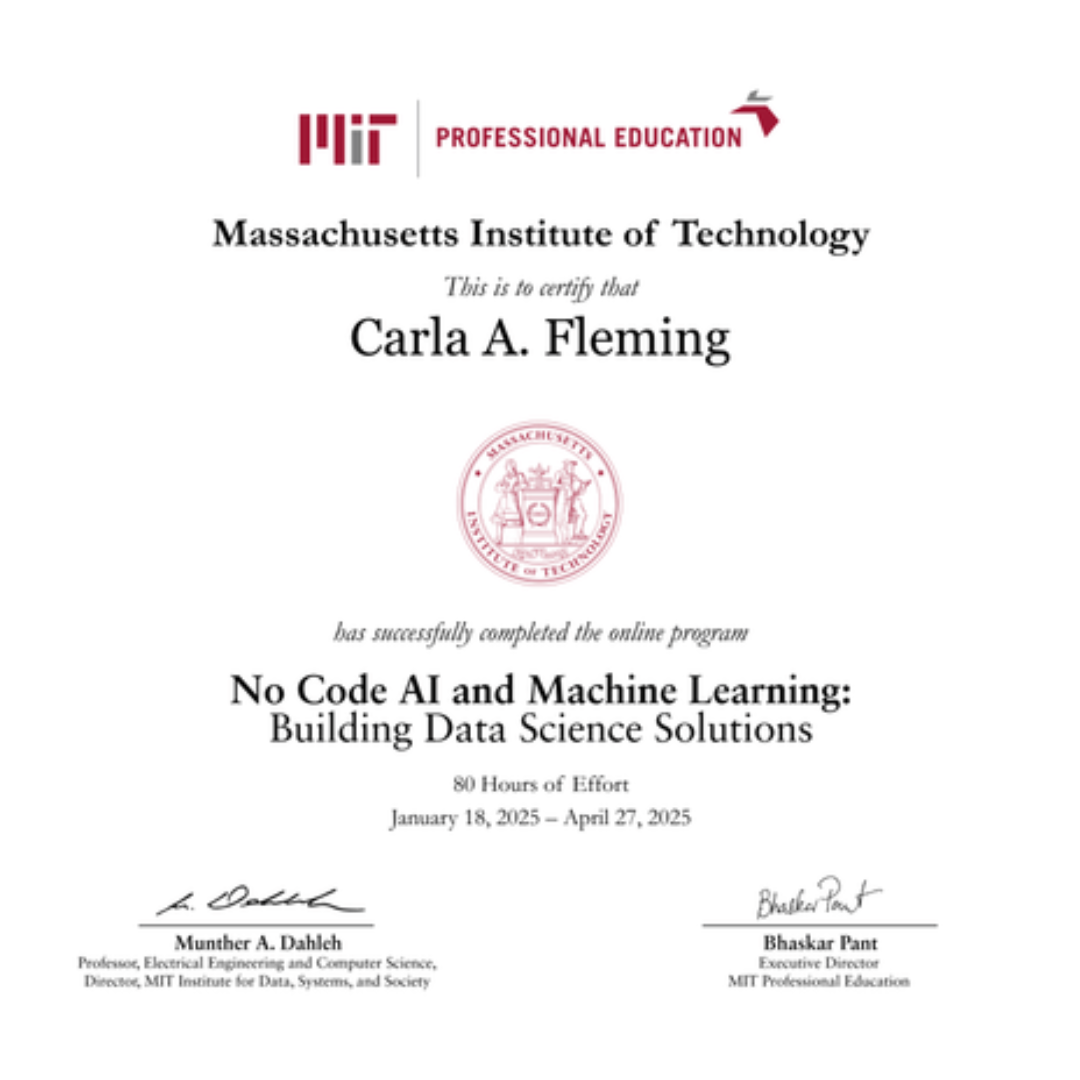
I am so delighted to share that I completed the MIT Professional Education no-code AI/ML class! My goal was to gain a deeper understanding of AI and its applications in personalization.
What have I learned?
🌟 How it works. AI has multiple components, like Generative AI, Deep Learning, and Neural Networks. The program delved deeply into how each one works and how to use it with structured data (data in databases and spreadsheets) and unstructured data (such as pictures, text, audio, and video).
🤖 Cutting Edge Technology. We conducted a hands-on case study using Google's Teachable Machine to build, train, and test a model on images of rice, classifying the different types. This is a technique more e-commerce companies may use to sort inventory, saving time and money.
⚖️ Explaining AI Limitations. Every technique and method has its advantages and limitations. For example, a Decision Tree is used to identify the patterns and behaviors to explain customer decision-making outcomes. However, the larger the decision tree, the more it approaches infinity, and creates a black box situation where it’s difficult to explain the model’s prediction. Understanding the limits is key.
📊 Overcoming My Fear of Statistics. At the program's outset, most participants were somewhat rusty or unfamiliar with statistics. MIT’s prep classes were excellent because they grounded discussions in the history of statistics and how it’s an integral part of AI. Over time, I became more comfortable with specific aspects of statistics used to evaluate whether models were overperforming or were sufficiently fine-tuned.
🧠 Changing the Way We Think. AI requires parallel thinking. It requires stakeholders to do things simultaneously: anticipate the outcome that answers the question, and consider the policy implications and consequences of automating the decision.
For example, who should we personalize or recommend a product or service for? What is the precise customer journey when we should make that recommendation to address a specific customer emotion, such as fear or confusion? When have we crossed the line? This is where human intervention becomes key when using AI.
📱 Changing the Way We Work. Today, no one does sums in their head when a calculator is on their phone. Just like the calculator, AI is a tool that provides answers to questions, helping to quickly advance insights. We have to check for accuracy.
What’s Next?
The journey continues. With over 30 case studies to ponder, I’m looking forward to integrating AI more deeply into the growth strategy work I do. This includes leaning into agents to automate specific processes.
As I was explaining to a friend over lunch, lean into AI. Start small and experiment. You’ll be surprised at what you can learn with small steps as you build an AI habit. Then, perhaps you take an AI course and share your experiences.